
Don't Raise Emus in Montana and Other Homestead Advice
On living with nature.

When I first bought Mossygoat Farm in 2015 old Roy was at my doorstep within the first couple of days. He said my fields will grow and become a fire danger when they dry out (he did have a point there) and that he could help us by putting his cows on our fields to eat them down. Before I even knew what was happening, I agreed to two small herds, one Angus and one Dutch Belted. We agreed on a field rental price and Roy moved in his cows the next day.
This could be the part of the story where I mention the dashboard calendar of his lackey with the naked wife photos, or when Roy took over two hours to fail load a bull in a trailer, swearing and telling dirty jokes the whole time and then I came along and had the bull loaded by myself in 15 minutes. But this isn’t about Roy stories (everyone in my town has them), this is about homesteading with nature. This is the story of how I got our first cows. Molly Moo, a Dutch Belted, had an Angus cross heifer and there was some disagreement with the owning parties on if the Dutch Belted group owned the heifer or if the Angus group owned it. The solution to the problem was to not pay us rent but instead pay us with cows and quite honestly, I was perfectly happy with that decision. We had cows! The worth of the cows was well above the agreed upon rental price and was something I had envisioned for our property but didn’t feel like I could afford it at the time.
But here is the thing: I love cows! I love cow kisses and cow love and everything cow, but my property doesn’t love cows.
Mossygoat Farm is located in the Pacific Wet West in the foothills of the Coastal Mountains. We are less than 10 miles, as the crow flies, from Laurel Mountain, which set a rainfall record in 1996 for the highest annual rainfall in the continental U.S. when it received 204 inches of rain.
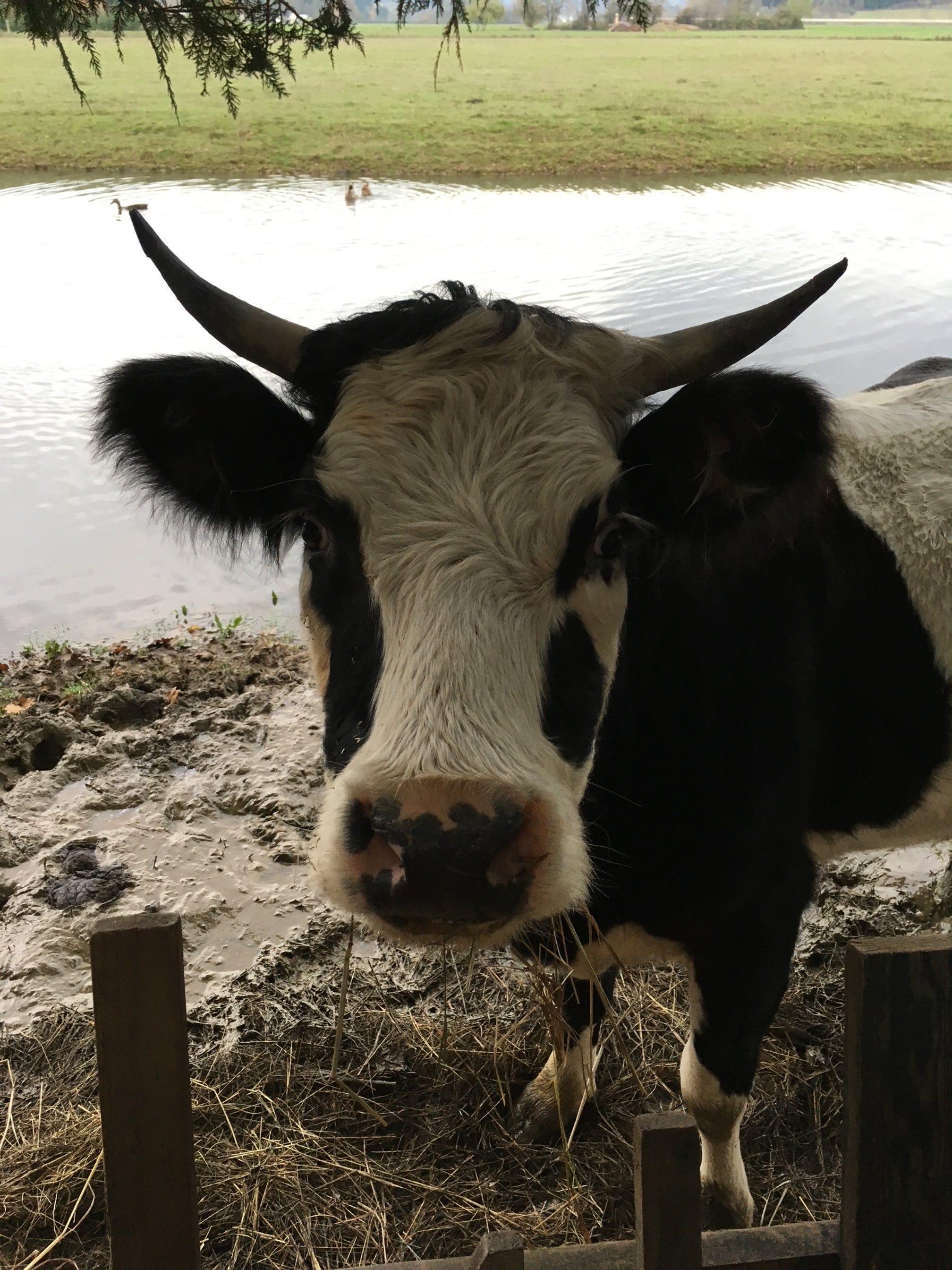
One of the first things I learned about owning cows is that they ruin my pastures. One winter while owning Molly Moo we received over 100” of rain. Molly Moo was a smaller cow, weighing in at about 800 pounds, but she carried high environmental destruction. I don’t have a barn large enough to over-winter cows, sheep, and horses so the cows stayed in the field with natural shelter. The area around the eating stanchion became what I call mud-soup, and you can see it in the above photo.
This was a cattle farm in the 1960’s and 70’s when a judge and gubernatorial candidate lived here. His daughter visited us one day and told the story of how her dad would get so mad at the mud that he would just pour random patches of concrete to help combat it. I can confirm that yes, we do indeed have random squares of concrete.
I noticed that my 3 horses had less of an environmental impact than 2 cows. I also noticed that the parts of my property with sheep did not show winter pasture damage.
When I sent the last of my cattle to freezer camp it took 3 years for the land to recover. In the history of this property before us, it also was a sheep farm in the 80’s and 90’s. I am somewhat convinced that the property itself wants sheep and it took about 5 years of living here to figure that out.
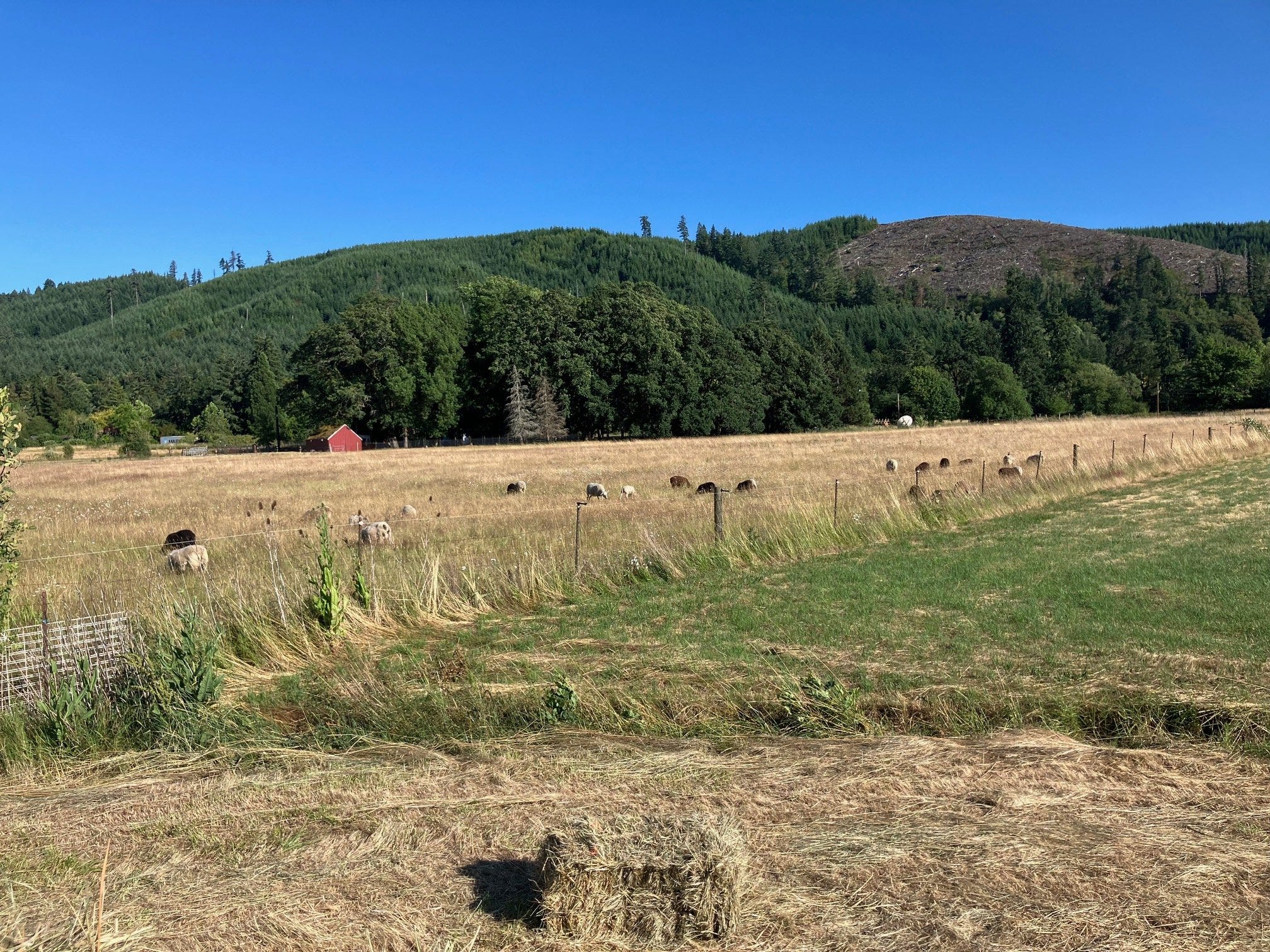
Living with nature extends to plants as well as animals. Learning what the land wants can take some time and I can’t tell you how many trees and plants I have unsuccessfully planted, even native ones, to learn this lesson. I am not prone to putting large amounts of foreign inputs into my garden or orchard. I will add wool pellets and homemade compost and call it a day. I could fight what the land wants and plant eggplant and peppers and add more inputs or I just could be happy with what is easy to grow here, on the Mossygoat soil. I will never have a peach tree, but plums and old variety apple trees thrive with no intervention. Squash are successful but tomatoes are iffy. I have learned to figure out what environment a vegetable is native to and if it matches mine, then it may be successful. A vegetable may grow in my USDA zone but that is a temperature-based zone and has no bearing on the actual growing conditions.
I focus on native plants, but I swear my property has rejected native plants as well. I have a row of evergreen huckleberries that have not grown more than a few inches in the 10 years I have had them. I have added natural inputs to make the soil more acidic, I have made sure they have the proper sun/shade ratio, and have chosen to both water them and not water them. No matter what I do I cannot make these evergreen huckleberries grow! The resident deer may be involved in this but that’s a different story.
When you start living with nature and tending the land you begin to notice what the land wants, and you stop fighting nature.
If you want chickens on your homestead, make sure you are getting breeds that match your environment. A hardy Buff Orpington may not be the fanciest looking chicken around but is well suited for cold. Emus may sound like a great money making venture but if you live in Montana, I would think twice because the environment emus thrive in is vastly different. Yes, you can theoretically grow olives in my area, but I would focus on filberts instead unless you have the financial capital to lose an entire olive orchard.
Learning to work with nature, instead of trying to force nature to do something it is not designed to in your area, should be the default path to follow but I am constantly amazed at how many people do not follow this simple advice.
Thank you for reading and please subscribe for more feral farm advice or consider buying me a cup of coffee or making a purchase from Wild Wisdom Wool. Thank you, I appreciate you being here.